

Cybermindr Insights
Published on: December 12, 2025
Last Updated: May 11, 2026


According to IBM’s Cost of a Data Breach Report 2025, the global average cost of a data breach this year was $4.4 million. Phishing accounted for 30% of attacks, underscoring the persistent vulnerability of human error in the security landscape. Simultaneously, supply chain breaches increased to almost 20% of all incidents this year, up from 15% in 2024. This highlights the risks that traditional vulnerability management tools cannot address alone.
This is where Adversarial Exposure Validation (AEV), a security approach that simulates real-world adversary tactics to validate whether theoretical exposures can actually be exploited, helps organizations. This article explains what AEV is and its benefits, while outlining the best practices for seamless integration. Further, it provides a roadmap for AEV’s adoption, empowering security leaders to turn exposure validation into a competitive edge.
Gartner’s 2025 Market Guide for Adversarial Exposure Validation defines AEV as “technologies that deliver consistent, continuous, and automated evidence of the feasibility of an attack.” Gartner positions Adversarial Exposure Validation (AEV) as an emerging category within the Continuous Threat Exposure Management (CTEM) framework, emphasizing continuous, automated evidence of the feasibility of attacks.
These technologies confirm how potential attack techniques would successfully exploit an organization and circumvent prevention and detection security controls. They achieve this by performing attack scenarios and modeling or measuring the outcome to prove the existence and exploitability of exposures.
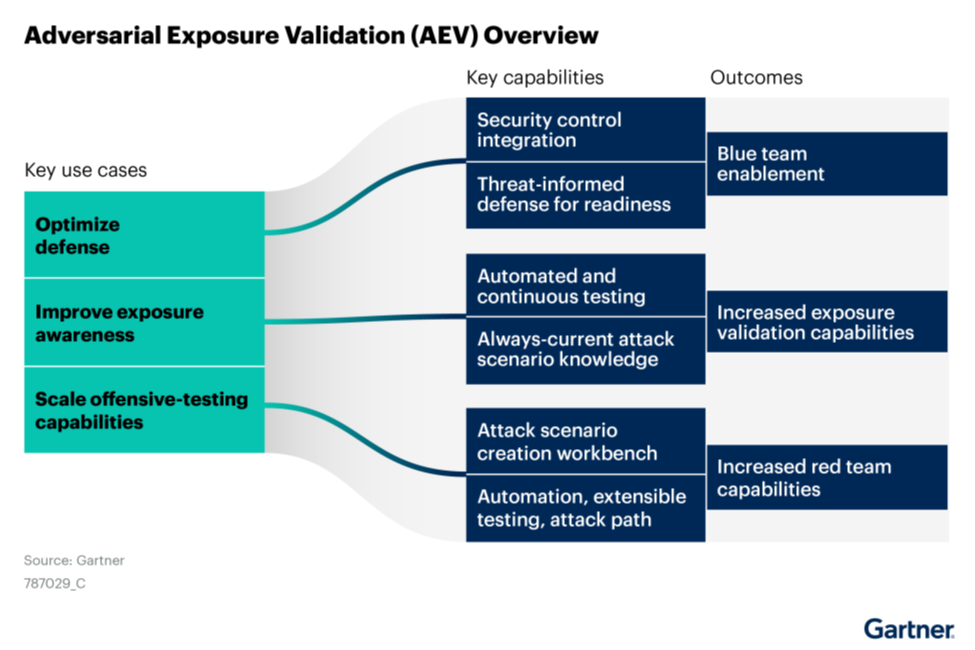
At its core, AEV bridges the divide between offensive and defensive security by generating real-time, evidence-based insights into an organization's attack surface. Further, as advanced threats like artificial intelligence (AI)-fueled attacks proliferate, AEV enables teams to move from reactive firefighting to proactive fortification. Gartner says that Adversarial Exposure Validation technologies have a few common and mandatory features.
The key difference between AEV and traditional vulnerability management is that the latter identifies potential weaknesses, and Breach and Attack simulation (BAS) platforms test the effectiveness of security controls. However, AEV verifies exploitability and provides a "pass/fail" decision on whether a threat actor can chain exposures into a breach. AEV closely aligns with the validation and mobilization stages of the Continuous Threat Exposure Management (CTEM) process.
Unlike traditional tools, such as vulnerability scanners and BAS platforms, AEV goes further and focuses on empirical outcomes, proving if a control exists and whether it works against real threats.
AEV offers several benefits, which include:
AEV has numerous real-world use cases. For example, a company in the financial sector can run AEV against phishing simulations to validate email gateways, catching credential-harvesting attempts. Manufacturing companies can use it to rank supply chain exposures, mitigating breach vectors. Companies leverage AEV-like validation to continuously assess internal and third-party security posture, complementing, but not replacing, security rating platforms.
AEV adoption is not just about technology; it needs the right execution to maximize ROI. The following are some of the best practices to adopt AEV in your organization.
Successful implementation of AEV involves a phase-wise rollout according to maturity levels rather than a one-shot execution. It is good practice to give sufficient time to implement a full-scale rollout. The following is a phase-wise implementation of AEV.
Phase 1: Assessment & Planning
Begin the implementation with a maturity audit. Map your attack surface using tools like asset inventories and gap analyses and frameworks like MITRE ATT&CK. Next, define specific outcomes. Issue RFPs focusing on criteria, such as multi-vector support, empirical reporting, and integrations. Finally, select 2-3 vendors for demo. Make sure you assemble a cross-functional team involving security, IT, and compliance for this phase.
Phase 2: Pilot & Initial Deployment
Deploy the solution and resources initially in a sandbox. Run baseline simulations targeting high-risk vectors, such as credential theft. Measure against defined KPIs. Automate weekly runs, embedding within CTEM workflows to validate remediation effectiveness. Refine any hiccups like false positives with the vendor’s support.
Phase 3: Scaling & Optimization
Extend the implementation to cover all vectors and assets. Embed adversarial exposure validation in workflows. This builds confidence and reduces breach costs. You can leverage AI-assisted analytics to dynamically correlate exposures and prioritize attack paths, as highlighted by Gartner.
Besides these three phases, it is necessary to monitor and iterate on an ongoing basis. Quarterly reviews track metrics like exploit success rates. Report the observations to the relevant stakeholders via dashboards. Adapt to trends. Perform annual vendor audits to ensure alignment with your organization’s goals.
Adversarial exposure validation marks an evolution in how organizations perform security testing and defend themselves against cyberthreats. It provides a more precise and actionable view of risks and shows how cybercriminals could exploit your systems. As it closely aligns with the CTEM framework, it plays a critical role in providing continuous, scalable validation across all attack surfaces as organizations adopt CTEM.
From outcome-focused planning and frequent testing to a phased rollout, the best practices and roadmap described in the article empower teams to validate, prioritize, and fortify their defenses with precision.
Ready to strengthen your exposure management program?
Book a CyberMindr demo today.